Key Takeaways:
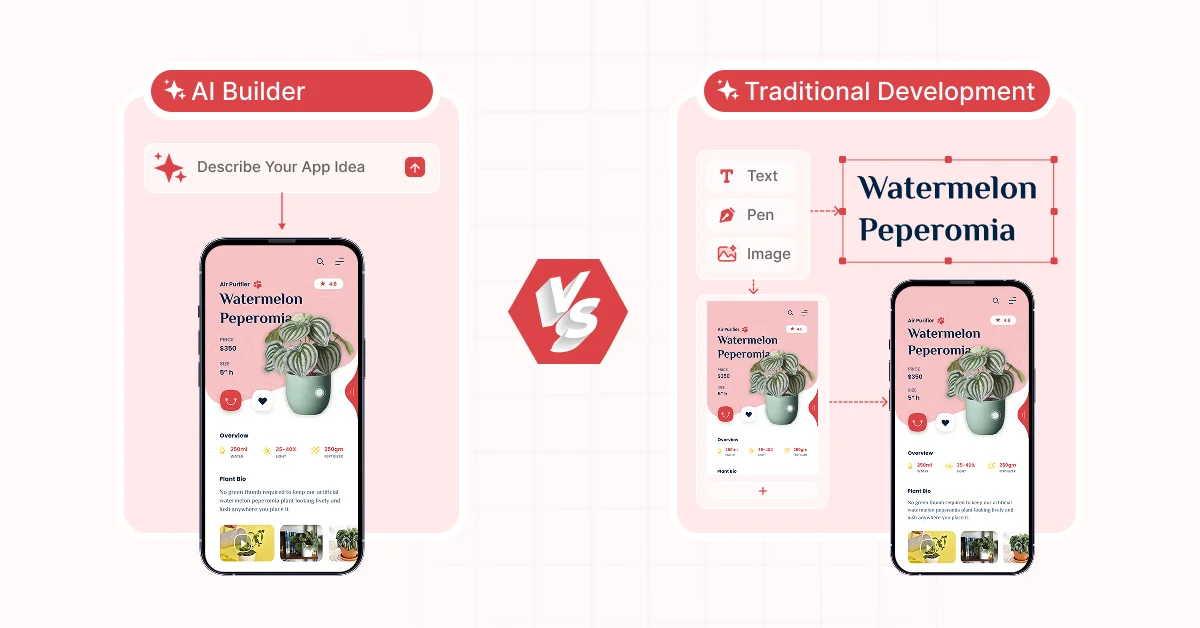
- The major difference between the AI app builder VS. traditional development is in its development approach, logic and predictability, scalability, user experience, control, and source code ownership.
- AI app builders excel at early product validation by compressing weeks of hand-coding into minutes, allowing founders to test core assumptions and UI patterns.
- Among speed, cost, and control, AI app builders can be considered the best for your app development.
- Nativly can help you convert your app idea into a quick success within a few hours or weeks.
Should you build faster with an AI app builder or need to invest in traditional development?
Well, the answer completely depends on how you see an AI app builder and traditional development in the case of your project. Both of the elements have their own pros and cons.
AI app builder helps users to launch the app quickly with speed, and at a low cost, while in the case of traditional app development, you can launch the app with complete customization.
In this guide to AI app builder vs. traditional development, let’s get ahead with what an AI app builder is, the key differences between the two, and then which is the best approach for your project.
Without any further ado, let’s begin.
What is an AI App Builder?
An AI app builder is a software platform that makes the use of artificial intelligence to automate large parts of application development.
AI app builder automatically handles the heavy lifting of traditional software development, such as writing frontend interfaces, backend logic, security scans, and server hosting. This is a platform where you can build the entire structure and functionality of your app for you based on the conversation you have with it.
With the AI app builder, you communicate your intent, and then it executes the code. An AI app builder handles three core layers of development.
First: AI app builders generate the user interface (UI), creating screens, buttons, and even forms that look professional.
Second: AI app builders structure the database, identifying how to store user data like profiles or inventory.
Finally: These AI app builders write business logic, ensuring that when a user clicks on “buy,” the app actually processes a payment and even updates the stock level.
Now, let’s proceed with what traditional development is.
What is Traditional Development?
Traditional coding is a rule-based software development method that is a linear and sequential approach, such as the waterfall model or classic System Development Life Cycle (SDLC), where each phase should be completely finished before the next one begins.
It is a key approach to growth and development that humans have used for thousands of years across different cultures, continents, and latitudes.
Traditional coding is all about how things have been done for years. It is the method where developers write every line of code by hand to create software. It is converting app ideas into success by following the complete process from market research to deployment.
The coding is manual, where you write the code yourself and control everything; you are in charge of every detail, fixing bugs, and writing functions. Additionally, it is a skill game and is slow.
Most of the startups also ask about AI app builder vs. hiring a developer.
An AI app builder lets you generate an app with natural language, whereas hiring a developer is all about giving you a custom-engineered software product built and maintained by a human expert.
Now, for the differences, let’s get ahead with the AI app builder vs. traditional development in the next section.
AI App Builder vs. Traditional Development
AI app builder is a software platform that helps you create working web, mobile, or even desktop apps with the help of plain-language descriptions instead of traditional programming.
On the other hand, traditional development is a sequential approach that includes core phases of app development, from identifying the requirements to deployment and maintenance.
Here is the list of key differences between AI app builder vs. traditional development:
| Factor | AI App Builder | Traditional Development |
| How it’s built | Plain-language prompts generate UI, logic, and data | Developers hand-code from scratch |
| Speed | Prototype in hours or days | Months for a production app |
| Upfront cost | Low (platform subscription) | High (team, agency or salaries) |
| Long-term cost | Licence fees plus review and rework | Higher build cost, steadier maintenance |
| Customization | Limited by what the AI generates | Unlimited |
| Code ownership | Varies by vendor (check export options) | You own the code |
| Security and governance | Needs human review and guardrails | Built to your own standards |
| Integrations | Common APIs, with gaps for legacy systems | Any system, including legacy |
| Scalability | Good for pilots and internal tools, uneven for complex systems | Highest |
| Who builds it | Business users, with developer review | Professional engineering team |
| Best for | MVPs, prototypes, internal tools, fast pilots | Regulated, complex, or proprietary products |
Let’s get into the details of the differences between AI app builders vs. traditional development:
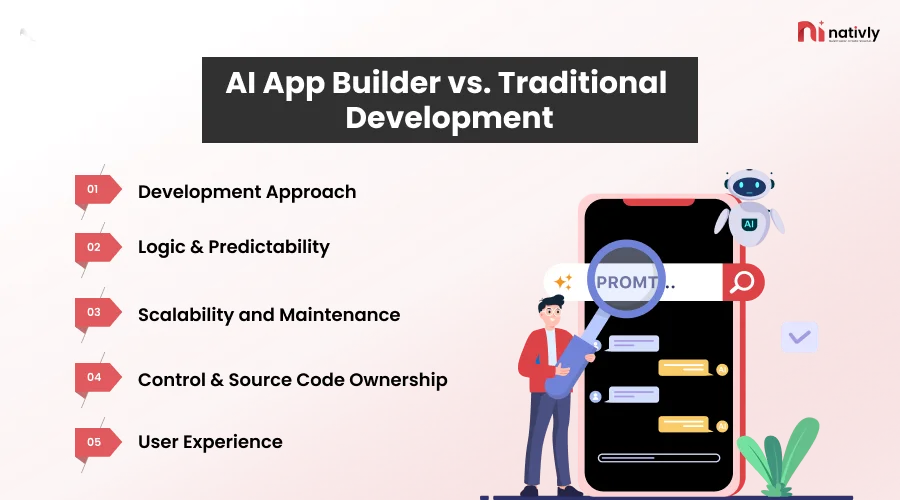
1. Development Approach
AI App Builder: The development approach for an AI app builder relies on natural language prompting and iterative refinement. This approach turns the concept into a functional app with AI.
Traditional Development: The traditional development approach for a trading app follows a structured, multi-phase lifecycle designed to handle low-latency data, along with strict regulatory compliance.
Also Read: “How Much Does It Cost to Build a Mobile App Via an AI App Builder?”
2. Logic & Predictability
AI App Builder: An AI app builder offers logic and predictability by combining natural language translation with structured architectural templates and human-in-the-loop controls rather than relying on raw, unconstrained code generation.
Traditional Development: Traditional development builds logic and predictability because it is a linear, sequential process where each phase must be completed before the next phase begins. You can minimize ambiguity and can create a highly controlled environment.
3. Scalability and Maintenance
AI App Builder: Scalability and maintenance change fundamentally, including managing the growing user traffic and keeping the code and prompts reliable over time. It transforms an AI app from a fragile prototype into a reliable long-term product.
Traditional Development: Traditional software development handles scalability and maintenance through manual control over system architecture and resource allocation. Scalability and maintenance offer foundational control and structural architecture under traditional development.
4. Control & Source Code Ownership
AI App Builder: Control and source code ownership are key elements when you look for an AI app builder. The source code is the underlying code that helps to make the website and application work.
Traditional Development: In this case, you do not have any vendor lock-in, and it gives organizations full control over customization, and direct ownership of every line of code, while AI app builders trade some of that control for rapid speed and automated development.
5. User Experience
AI App Builder: AI app builders create a great user experience by removing the technical hurdles and accelerating how the software is designed, tested, and deployed.
Traditional Development: When it comes to traditional development, it offers a superior user experience through total design freedom, high performance, and precise control for every interaction.
You might also consider a complete guide to building an enterprise guide with AI for evaluating the right process for app development with AI.
Now, one of the questions that most of the startups and entrepreneurs often ask is, “Where to use AI app builders, and where to use traditional development?”
Let’s look at the following section for the same.
Where AI App Builders Win for Early Product Validation
AI app builders win at early product validation by shrinking the months of custom coding or even expensive development sprints into the matter of hours, allowing founders to test real user demand before committing heavy capital.
AI app builders do helps the founders rapidly create the MVP because they let you launch a testable prototype faster, and that too at a lower upfront cost, so that you can gather user feedback before committing to a full build.
It helps in rapid prototyping, testing real behavior, and even low-cost pivoting. This even collapses the time and cost required to get a working, interactive artifact in front of real users. The AI app builders win for UI component & design acceleration.
AI app builders win for early product validation, from zero to prototype speed, real device and browser testing, low-cost experimentation, and bridging the gap between web and mobile.
Where Traditional Development Still Wins
Traditional development wins when building high-scale, mission-critical, and complicated systems that demand deep architectural control and even complete customization.
Additionally, traditional development wins over AI app builders because:
- Complex, highly customizable features and business logic
- Deep integrations with existing or legacy systems.
- Full control over code, architecture, and deployment
- Security, privacy compliance, and control over data.
- Long-term maintainability and reduced platform lock-in.
Hence, if you want complete control, maximum performance, and deep customization that a pre-built platform or no-code platform cannot handle, it is important to go for traditional development to create an app.
So Which One Wins on Speed and Cost, Control, and Quality?
Comparing the AI app builders and traditional app development across speed, cost, control, and quality shows a clear trade-off between rapid prototyping and enterprise-grade engineering.
Here, no one wins permanently on all three without a strategic paradigm shift. Let’s look at the given table to learn it all:
| Parameter | Winner | Why |
| Speed | AI app builder | Gets a prototype or MVP in users’ hands sooner. |
| Upfront cost | AI app builder | Usually needs less initial time and engineering spend. |
| Control | Traditional development | Gives greater control over code, architecture, integrations, and deployment. |
| Quality | Traditional development for production; AI app builder for quick validation | Custom engineering supports more rigorous testing, reliability, and complex requirements; builders are effective for testing basic flows quickly. |
Which Approach Should You Choose Based on Your Product Type and Why?
Selecting the right approach depends on whether you want a highly customized app or minimal customization that AI app builders can handle.
Here’s why you need to select an AI App Builder:
- Select an AI app builder like Nativly to validate your idea quickly in the market.
- Want to create a straightforward app? (With Nativly, you can get additional support from an engineering team).
- Additionally, Nativly is best suited for turning an existing website into an app for iOS and Android.
Thus, Nativly is the best AI app builder if you are thinking of choosing an AI app builder for your next project.
If you want a highly customizable app, going for traditional app development is the best option for an AI app builder.
Conclusion
The major difference between an AI app builder and traditional app development is in the development approach. AI app builder relies on natural language prompting; however, the traditional development approach follows a structured lifecycle.
Another key difference is in the user experience: an AI app builder removes the technical barrier, while traditional development offers a superior user experience via total design freedom and precise control for every interaction.
Selecting one approach depends on your project, the type of app you want, and what kind of purpose you want to achieve with your app idea.
FAQs
Q1. What is the difference between an AI app builder and traditional development?
AI app builder uses natural language prompts, visual interfaces, and automated workflows to create and deploy apps in days or weeks, while traditional development relies on manual line-by-line coding executed by human engineers.
Q2. What are the parameters to consider when selecting the right approach between an AI app builder and traditional development?
The different parameters that you should consider are what your target is for creating the application: whether it requires high customization, speed and time-to-market, cost and resource investment, security, and compliance.
Q3. Where do AI app builders win for early product validation?
AI app builders win for early product validation by collapsing the time-to-prototype window from weeks to hours, allowing the founders to test the real-world demand before committing any expensive engineering resources. This is all about shrinking the time and cost required to turn an idea into an interactive and testable artifact.
Q4. Are AI app builders cheaper than traditional development?
Yes, AI app builders are cheaper than traditional development; here, you can launch your app quickly. AI app builders typically cost between $19/month and $199/month, depending on the project type and features you want to add. However, under traditional development, the cost can vary from $15,000 to $100,000. Here, the cost again varies depending on project size, type, and platform used.
Q5. Should we build, buy, or partner if we create an app?
The decision of whether you should build, buy, or partner depends on the factors of what you want to create. It depends primarily on how central the application is to your core business differentiation and how fast you want to get to market. If you app demands high customization, it is better to go with traditional development.