

Key Takeaways:
- The overall cost to build a mobile app via an AI app builder varies from $29 to $499/month.
- This cost varies depending on factors like hidden costs, complexity of your app, selection of tech stack, design, third-party APIs, and deployment to platforms.
- Major challenges that founders face while selecting the cost are vendor-lock-in and App Store or Play Store rejections, lack of knowledge, and fear of building an unrealistic app.
- Best practices to adopt are expert advice, learning in-depth about AI app builders, optimization of AI prompt efficiency, and monitoring token as well as API usage limits.
- Connecting with Nativly can help you to have efficient pricing methods, including a pay-as-you-go method.
With the growing trend of AI, many startups are shifting their focus to building and delivery app via an AI app builder.
AI app builders have provided founders a scope to build their own apps without completely depending on developers.
But these AI app builder tools have their own cost range.
Therefore, the question arises, “How much does it cost to build a mobile app via an AI app builder?”
This cost varies from $29 to $499 per month, based on the type of plan you adopt. Here, different factors such as the complexity of the app, design, backend, usage of AI inside the app, third-party APIs, testing, and app deployment matter.
In this guide, the cost estimation of building an app via an AI app builder is stated in detail. Here, we’ll walk you through the reasons, cost, its factors, and cost optimization practices.
Let’s get started with the concept.
What is an AI App Builder?
AI app builder serves as a platform that uses artificial intelligence to help users design, build, and even launch applications faster with minimal effort. Unlike the manual no-code tools that rely on drag-and-drop interfaces, these AI app builders enhance the process with automation and natural language capabilities.
With the help of an AI app builder, you create the complete app, not just a prototype. Here, the real app runs the workflows.
Here, the users just need to describe their complete requirements in natural language, and then AI takes the large part of the technical implementation. The AI app builders help to enhance the process of app development through automation and natural language capabilities.
Core features of AI app builders comprise natural-language prompting, Figma integration, integration ecosystem, backend generation, and prompt-based editing.
Here, many AI app startups often ask, “What are the benefits of using an AI app builder?”
The key benefits of using an AI app builder include building at the speed of thought, making your budget stretch further, and your words becoming the code here.
In the following section, you can learn the complete benefits of using an AI app builder.
Why Go for an AI App Builder in 2026?
There are many reasons why businesses should go for an AI app builder in 2026: it saves time, builds apps without coding, improves accuracy and scalability, helps to boost collaboration, and enhances creativity.
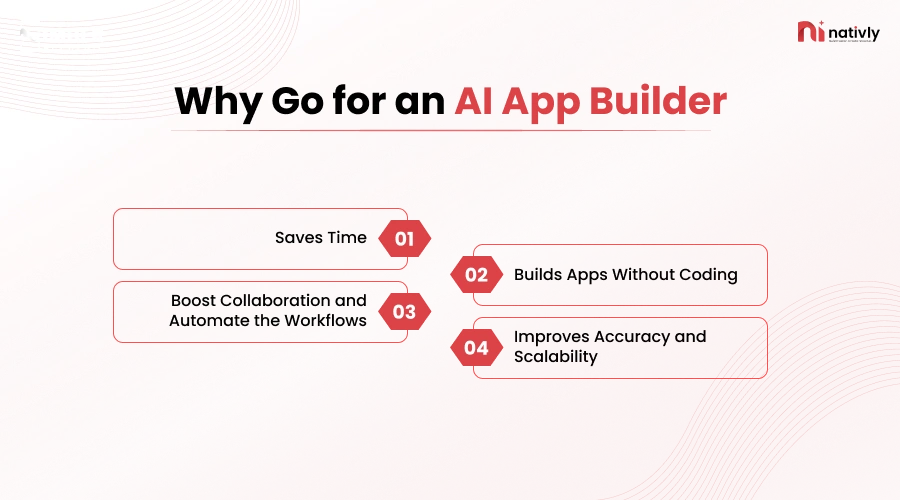
Here is the complete list of benefits to choose from when choosing an AI app builder in 2026:
-
Saves Time
One of the important benefits is, AI app builder saves time by translating plain language into functional software. This AI app builder automates repetitive setup tasks like writing code and configuring using the authentication.
-
Builds Apps Without Coding
AI app builder like Nativly includes a prompt interface, an automated code generator, which is a visual drag-and-drop editor, and is a one-click cloud hosting. These apps use large language models to automatically generate the user interface and database structure based on the prompts.
-
Boost Collaboration and Automate the Workflows
The intelligent app-building tools streamline team communication and even help to automate repetitive tasks through sending automated notifications and managing the complete workflow.
-
Improves Accuracy and Scalability
Another key benefit of using the AI app builder is that it enhances the overall accuracy and scalability by automating repetitive tasks and standardizing workflows across diversified applications.
Well, other than this, it automates the complete tasks, and businesses do not need a developer here; if they are aware of minimum coding, they can modify the code and update the prompts by themselves.
But now, the next question that most of the entrepreneurs and startups ask is “ how much does it cost to develop a mobile app via an AI app builder?”
The cost depends on various factors and determinants that confuse most of the people like you who are looking to build an app through an AI app builder.
Also Read “How to Build a Native iOS and Android App Without Coding in 2026?”
Why Does AI App Builder Pricing Confuse People?
The AI app builder pricing is confusing because it’s shifting its focus from predictable flat monthly subscriptions to token and usage-based pricing.
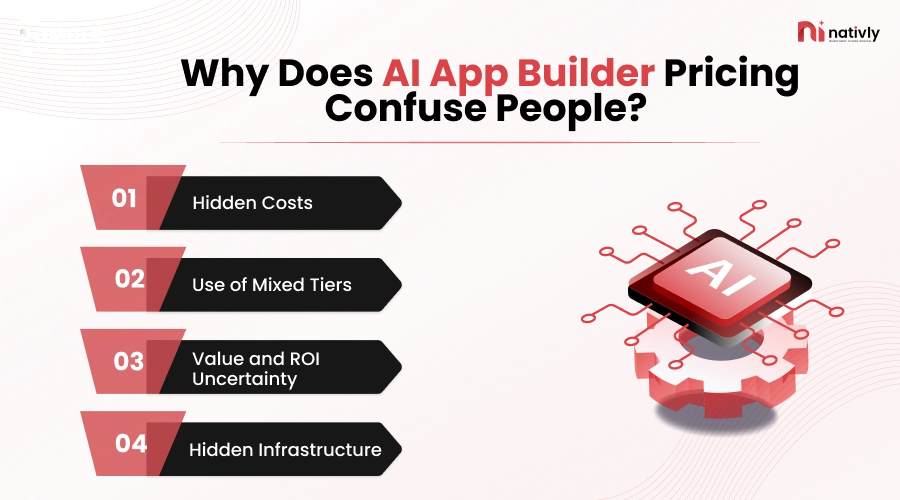
There are other reasons to consider:
-
Hidden Costs
The advertised cost often shows low monthly subscription tiers, along with real-world budgets that expand due to hidden expenses such as usage-based tokens and cloud computing demands.
-
Use of Mixed Tiers
There are various unpredictable usage tiers such as token consumption, API scaling, and tier jumps. Here, the vendors even use mixed tiers, such as they use subscription fees, along with per-token usage and API calls, which makes the overall bills unpredictable.
-
Value and ROI Uncertainty
The value and ROI uncertainty confuses people because it forces the buyers to weigh an upfront, known cost against an abstract proven benefit. Additionally, the buyers often mistake the high prices for exploitation and the low prices for poor quality.
-
Hidden Infrastructure
The background risks, database calls, preview deployments, and even third-party API connections drain credits far faster than the general visual edits. Thus, the hidden cost of infrastructure often results in confusion for people related to AI app builders.
But how much does it cost to build a mobile app via an AI app builder?
Well, this cost often depends on various factors such as subscription plans, usage limits, tokenization, types of tools, and many others.
Let’s examine them all in the following section.

How Much Does It Cost to Build a Mobile App Via an AI App Builder?
Building a mobile app via an AI app builder can cost you between $29 and $499 per month in subscription fees; it is paid directly to the platform to design, host, and maintain your application.
Apart from this, there are free subscriptions, enterprise plans, and even seat licensing that have an impact on the pricing of AI app builders.
This cost varies as you choose the different AI app builders. With the best AI mobile app builders in 2026, you can select the right AI app builder depending on your priorities and budget-friendly cost structures.
There are different factors impacting this cost.
To understand these factors, let’s get ahead in the following section.
What are the Factors Impacting the Complete Cost to Create a Mobile App via an AI App Builder?
One of the biggest mistakes that you might commit here is to just focus on the subscription fees or plan while evaluating the AI app builder cost. While the real cost is actually the combination of AI app builder fees, backend infrastructure, third-party services, and much more,
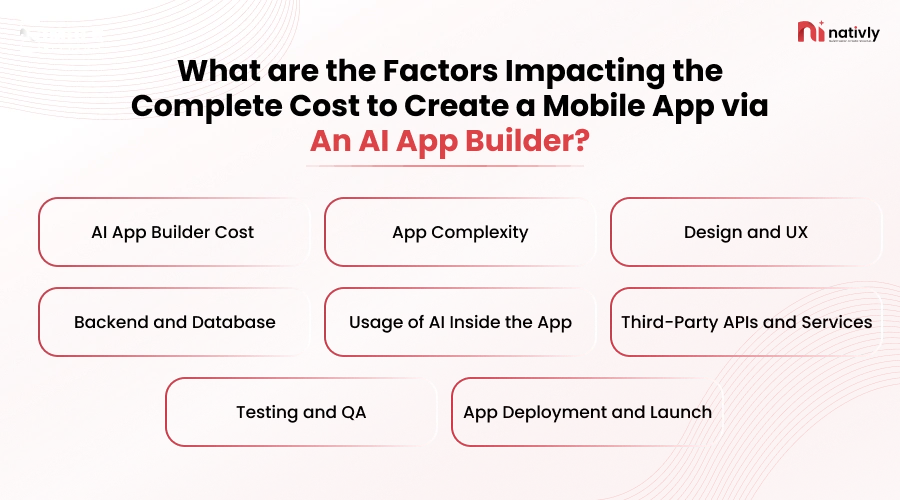
Let’s have a quick look at all the factors impacting the complete cost to build a mobile app via an AI app builder:
-
AI App Builder Cost
This depends on the platform and how much of the total development it automates. It includes the monthly and annual subscriptions, number of AI generations and prompts, AI credits and token usage limits set by the AI app builders, push notifications, and maps.
Here, the AI app builder cost includes higher-tier plans for commercial use, AI credits or even for private repositories.
-
App Complexity
The complexity of the app is the main factor because it dictates the data pipelines, model customization, and engineering hours required. This factor directly impacts the initial development of the app.
Sophisticated features such as automation and real-time processing have a huge role in raising the total development costs.
-
Design and UX
Another crucial aspect impacting the overall cost is design aspects, where you may need to budget for user flows, wireframes, UI design, branding, animations, and usability testing.
Here, the design and user experience represent the final price tag, which shifts costs from manual frontend coding to the platform subscription tiers.
-
Backend and Database
When you create an app via an AI app builder, you do not need to select the backend or perform all the coding by yourself. Well, when you write the code and prompts for building your app, one of the core segments here is stating the type of backend you want.
Hence, here the factors such as API server, authentication, database, and user management impact your decision.
-
Usage of AI Inside the App
Well, the usage tokens even have a higher impact on the AI app builder cost. Here, the number of times you type the prompts or correct the code while building the app also depends on the tokens allowed to you. This adds up to the whole cost while building an app via an AI app builder in 2026.
Here, the pricing models, such as subscription plans or credits, along with the ongoing API, help users to generate AI responses per day.
-
Third-Party APIs and Services
The number of services you add to your app while using the AI app builder has an impact on the complete AI app builder cost in 2026. Here, the third-party services comprise maps/location APIs, push notifications, address verification, and CRM integration.
Integrating the foundational AI models, vector databases, and authentication tool shifts expenses from the one-time development to the continuous operational costs.
-
Testing and QA
The overall testing and QA lowers the total cost to build an app via AI app builder by finding bugs early. The AI-generated applications can require more validation than just a simple prototype. Here, the budget for testing comprises slow networks and security.
Here, fixing a bug will depend on early fixes, fewer crashes, and even fewer reviews. Quality assessment during building the app will help you to identify errors and then reduce the costs of fixing them.
-
App Deployment and Launch
Another crucial factor affecting the overall AI app builder cost in 2026 is the cost of creating a mobile app. It radically shifts the cost structure by using an AI app builder from a low-cost design phase to a high-cost phase.
Here, if your AI app builder can connect your app to a deployment platform, it can affect your app’s pricing.
While deciding the cost to build an app via an AI app builder, let’s get ahead with the pain points that founders hit when pricing out these things.
Pain Points Founders Hit When Pricing Out the AI App Builder
There are certain challenges that fintech founders often face when pricing out the AI app builder. They frequently encounter severe price-to-reality mismatches, driven by volatile usage-based pricing and aggressive platform markups.
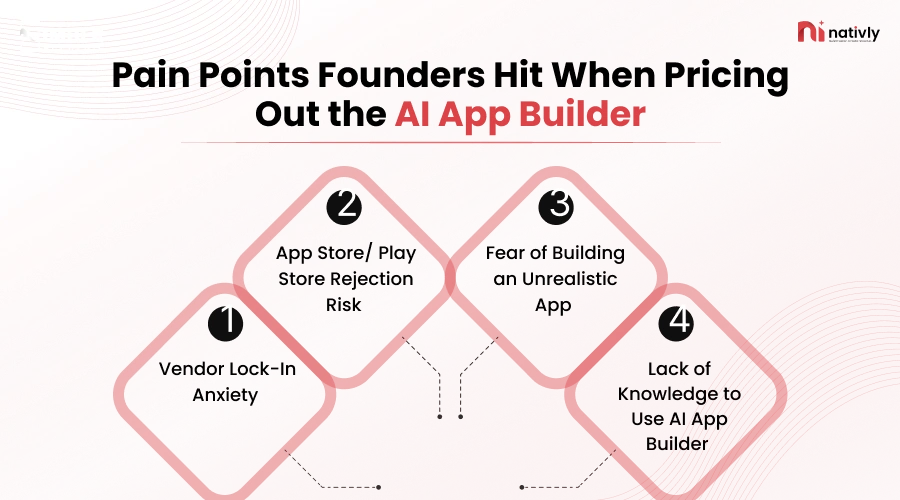
Here’s the list of pain points that founders hit when pricing out the AI app builder:
-
Vendor Lock-In Anxiety
The founders often fear to have a vendor lock-in, because it traps the founders and makes them dependent on the AI app builders. This even results in increasing the overall cost of using the AI app builder.
The vendor lock-in happens due to proprietary code, custom integrations, model dependency, and data silos.
-
App Store/ Play Store Rejection Risk
Another crucial challenge faced by AI app builders is what if an AI-generated app got rejected by the App Store. Founders using AI app builders face a challenge to deployment.
It is a challenge because, due to a lack of effective prompts, these tools generate low-quality template code. Additionally, it includes third-party tracking scripts that violate complete privacy rules.
-
Fear of Building an Unrealistic App
AI app builder runs and follows a defined template, which can be a challenge in building a realistic mobile app.
Here, the founders demands the high-complex apps with realistic features, but they ignore cost-driven factors such as high computation costs and API costs that are crucial to build such complicated apps.
-
Lack of Knowledge to Use AI App Builder
Many founders lack knowledge to use an AI app builder wisely. This creates a specific challenge, where these founders cannot write clear prompts and are unable to fix technical errors in the code if required.
Due to a lack of knowledge about how to use the AI app builder, the challenge remains.
With these challenges, what can be the right practices to adopt while building an app via an AI app builder?
Best Practices to Adopt for Minimizing the Cost
If you are aware of using AI app builders and have a developer by your side, this can be the first step to take for building a mobile app.
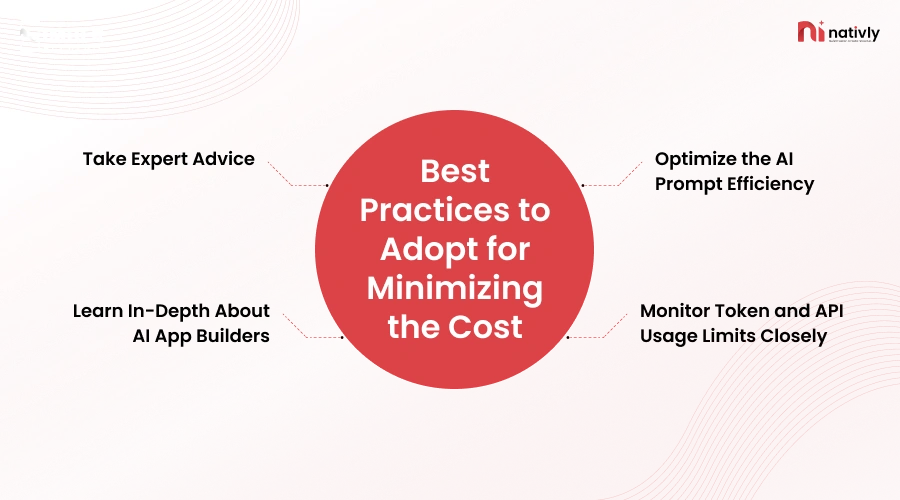
Let’s evaluate the complete list of best practices:
-
Take Expert Advice
You need to select an AI app builder that is backed by an expert developer team. If you are not a technical expert or have little know-how of app development, then hiring a developer or connecting with professionals should be on your list.
If you have the right advice to use the AI app builder in your way, it will definitely cut the total cost.
-
Learn In-Depth About AI App Builders
Another crucial practice is to know about AI app builders and what good app builders are present in the market. You should evaluate their performance via a free check before you depend completely on them.
You should learn in-depth about these builders that can help you create software without coding.
-
Optimize the AI Prompt Efficiency
You should optimize the AI prompt efficiently by using clear structural frameworks and being direct when assigning a specific persona. In the prompt, you can divide the complete app development task into simple sections.
Sections help the builder read instructions carefully and then build your app by following the right steps.
-
Monitor Token and API Usage Limits Closely
To optimize the complete cost, you should monitor token and API usage limits. This proactive tracking avoids sudden blocks while building an app via an AI app builder. Implementing multi-layered controls helps prevent unexpected financial spikes.
It even helps in detecting runaway loops in code, enables experts to set hard budget caps, and even alerts you if any error arrives.
Which AI App Builder has Budget-Friendly Pricing?
Nativly AI is the best AI App Builder that has budget-friendly pricing based on your demands of app.
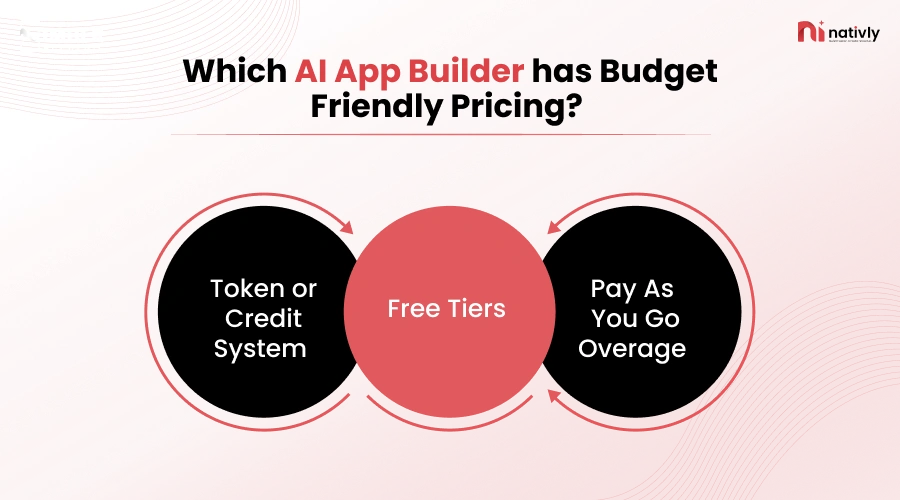
Here are multiple reasons why Nativly is the best AI app builder to select:
-
Token or Credit System
You should evaluate its token and credit system, which is flexible as per your requirements. Tokens are the atomic billing unit for most LLM-based services, and the economics are nothing but are linear. Nativly is an AI app builder that allows users to adopt an effective token- and credit-based pricing system.
-
Free Tiers
Nativly has 3 transparent pricing systems that start from $29, $49 pro, and $399 as an agency, with no surprise agency-style quotes. Here, you will find effective and budget-friendly pricing schemes.
-
Pay As You Go Overage
Nativly doesn’t stop you from prompting; instead, it helps you pay only for the exact computer power, data usage, and actions as your app demands. Here, the pricing model proceeds as you go with app development. Means with Nativly, you pay for the exact result you get.

Conclusion
The overall cost to build an AI app through an AI app builder varies depending on diversified factors such as app complexity, design, backend you select, usage and prompting done under the AI app builder, third-party APIs, testing, and even app deployment.
There are several pain points that founders hit when pricing out the AI app builders, such as vendor lock-ins, app store and Play Store rejections, and a fear of building unrealistic apps. To avoid the challenges, founders should seek expert advice, optimize the AI prompts, be aware of the AI app builder, and monitor token and API usage limits.
FAQs
Q1. How much does it actually cost to build a mobile app with an AI app builder?
The cost to build a mobile app with an AI app builder varies from $29 to $49 per month, depending on the requirements, design, third-party APIs, testing, and complexity of the app.
Q2. Is $29 a month too good to be true for a real app?
Yes, $29 per month is a good start when building a real app via an AI app builder. It lowers the barrier for you to enter for solo builders and small teams, while establishing the complete perceived value.
Q3. Is it cheaper to use an AI app builder than to hire a developer or agency?
Yes, indeed. It will be much cheaper to use an AI app builder rather than depending on or hiring a developer or agency. For hiring an agency, you need to evaluate their skills, while for an AI app builder, you can remain assured about building your app as it is a well-trained system with expert skills. Hence, to hire developers, it will cost you a lot, irrespective of selecting the right AI app builder.
Q4. Can I actually own the code, or am I locked into the platform forever?
With Nativly, you can own the code, and you are not locked into the platform. Nativly offers you the freedom to operate the app at your risk and at your own pace.
Q5. What’s the cost difference between a starter plan and an agency-tier plan in Nativly?
The major difference between a starter plan and an agency-tier plan in Nativly is that with the starter plan, you can build 2 apps per month, while in the agency-tier plan, you can build 10 apps per month. Other than this, the starter plan includes 2 feature plans/ prompts per month. While with enterprise plan, you will get 5 engineers’ support.
Q6. How much should I budget to go from idea to a published app in 2026 with Nativly?
With Nativly, your overall budget to build a complete app till publish can be around $87 to $1497, assuming that your app can be built in 3 months. Here you should be specific about your requirements, as changing requirements in the middle of the month can increase the time limit and cost.