Key Takeaways
- AI app builders simplify app development with automation and minimal coding.
- However, hiring a mobile app developer is better for complex, customized, and scalable applications.
- The right choice depends on your budget, timeline, technical requirements, and project goals.
- To evaluate the difference between an AI app builder vs hiring a developer, compare both options carefully before starting your app development journey.
- Nativly AI can help streamline the app-building process with AI-powered tools.
As a startup and an entrepreneur, it is natural to remain confused about whether to use an AI app builder or hire a developer.
Hence, in this guide, we will talk about the complete series of steps, as well as the differences.
Without further ado, let’s get started.
What is an AI App Builder?
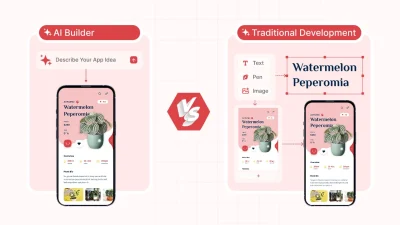
An AI app builder is a platform that helps you create fully functional software using plain-language descriptions instead of traditional coding.
You state the types of apps and different kinds of models you want with an AI app builder. Here, you tell the AI app builder about the type of features you want, primary use cases, and visual layout.
It is a platform that offers benefits such as no-code requirements, high-speed coverage, and even creates fully functional web and mobile applications from plain-language prompts and basic ideas without an experience of coding.
You can discover the best AI app ideas that you can create with an AI app builder. Even before evaluating the ideas, learning about how an AI app builder works is critical.
Here’s how an AI app builder works:
How Does an AI App Builder Work?
An AI app builder works by translating the plain-language descriptions into functional software via natural language processing, automated code generation, and conversational refinement.
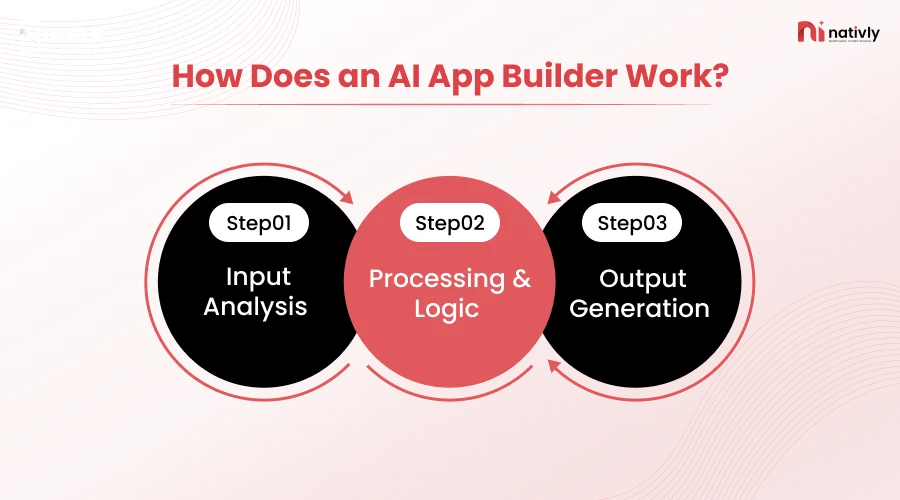
Let’s dive into the working process of an AI app builder as below:
Step 1: Input Analysis
You type a text prompt by describing your idea, desired features, and even the layout preferences. It is the foundational first step where an AI app builder intercepts, parses, and even decodes your natural language description
Step 2: Processing & Logic
Processing and logic is the second step in the working process of an AI app builder, because the system should understand the user’s input before it can write code or create any components.
Step 3: Output Generation
It is the third step, where the AI app builder shows the result of processing the input. Under this step, users can find results comprising database tables, fields and attributes, relationships, and APIs.
What Does an AI App Builder Comprise?
- Natural Language Processing: NLP parses the written instructions and ideas by stating what are the key prompts and automatically transforms them into functional logic.
- Automated UI/UX Design: An AI app builder offers automated UI/UX design by translating natural language text prompts and hand-drawn sketches into production-ready interfaces.
- Authentication and User Management: Authentication and user management are the key components of an AI app builder because they control access to sensitive data.
- Hosting and deployment pipeline: The hosting and deployment pipeline is a key component because it bridges the gap between the text prompts and experimental models.
- Integration Layer: The integration layer is the connective backbone in an AI app builder that further links the foundational AI models to the external data sources and user workflows.
Also Read: “How to Build a Native iOS and Android App Without Coding in 2026?”
Proceeding with the AI app builder, let’s get ahead with learning about hiring a developer in the next section.
All About Hiring a Developer
Hiring a software developer requires defining a complete project scope, which means recruiting a programmer or software engineer to write, test, and even maintain code for your website, app, and even software project.
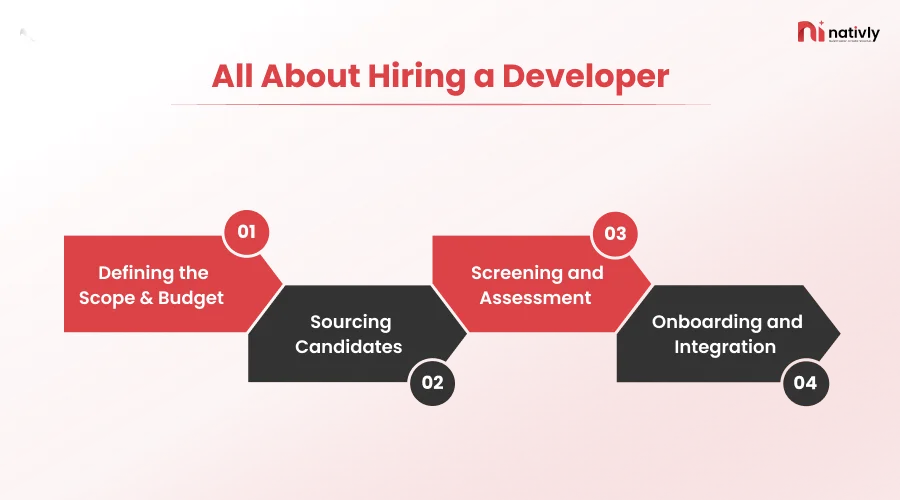
For hiring a developer in the market, you should follow a systematic procedure:
Step 1: Defining the Scope & Budget
When you hire a developer, it is essential to define a precise scope, and setting a realistic budget prevents inflated costs and failed software projects.
Here, you can set clear goals by outlining the short-term tasks and even 1-to 3-month milestones so you can have a practical deadline for your project.
Align with the current market rates to attract stable talent.
Step 2: Sourcing Candidates
Now, you should reach out to the target platforms to connect with the developers. It comprises proactive search, identification, and initial engagement of passive and active technical talent.
For sourcing channels for developers, you should search coding and portfolio sites. This can take months to hire a suitable developer to create an app.
It involves actively hunting for passive and active talent across the world and on technical platforms.
Step 3: Screening and Assessment
Now, you need to opt for screening and assessing your developers. This is a structured, multi-step process, where screening and assessment act as the core filter for validating real-world capabilities over resume claims.
Here, you objectively evaluate a candidate’s practical coding, problem-solving, and system design skills beyond what a resume can show.
This step is all about selecting the right candidate based on several factors, such as the requirements of the app, validates core coding competencies before investing expensive engineering hours in the live interviews.
Step 4: Onboarding and Integration
It is the final step in the process of hiring a developer because it bridges the gap between signing an agreement and achieving operational productivity within a complicated technical ecosystem.
This step transitions a newly hired developer from a trained newcomer into an employee.
Again, this step takes a period of a few months during which you need to connect with the developer and then assign them a list of tasks.
When you have an idea, it is important to validate an app idea before you build it.
Now, let’s get ahead with the key differences between an AI app builder and hiring a developer in the next section.
AI App Builder vs Hiring a Developer
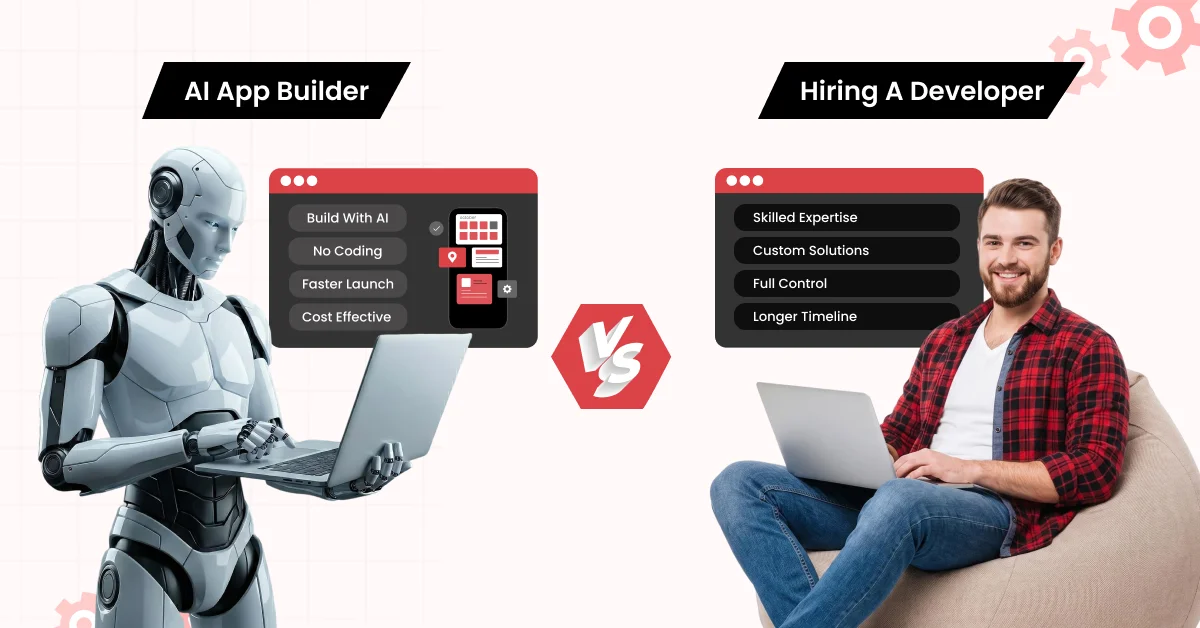
The differences between an AI app builder and hiring a developer vary due to different factors such as cost and speed, complexity, ownership, and maintenance.
Let’s get ahead to understand the complete list of differences between an AI app builder and hiring a developer with the given table:
| Factor | AI App Builder | Hiring a Developer |
| Cost | $0–$400/month | $5,000–$50,000+ per project |
| Speed | Days | 4–16 weeks |
| Best for | MVPs, validation, standard app patterns | Proprietary logic, complex integrations, high-stakes builds |
| Code ownership | Varies by platform (full export with tools like Nativly) | Yes, contractually |
| Handling complex/custom logic | Limited without human review | Strong — human judgment on edge cases |
| Code quality risk | Higher (~43% of AI apps ship with bugs unless reviewed) | Lower, but depends on developer skill |
| App Store readiness | Risk of rejection without human QA | Generally handled correctly |
| Long-term maintenance | Falls on you, unless a hybrid model is used | Ongoing cost, but expert-led |
| Non-technical founders | Fully accessible, no coding needed | Requires managing a technical hire |
| Scalability for complex apps | Limited alone | Strong |
How to Select the Best Route for Your Software?
To select the best route for your software, you need to evaluate several factors, including project requirements, complexity, budget, cost, time constraints, and even risk assessment.
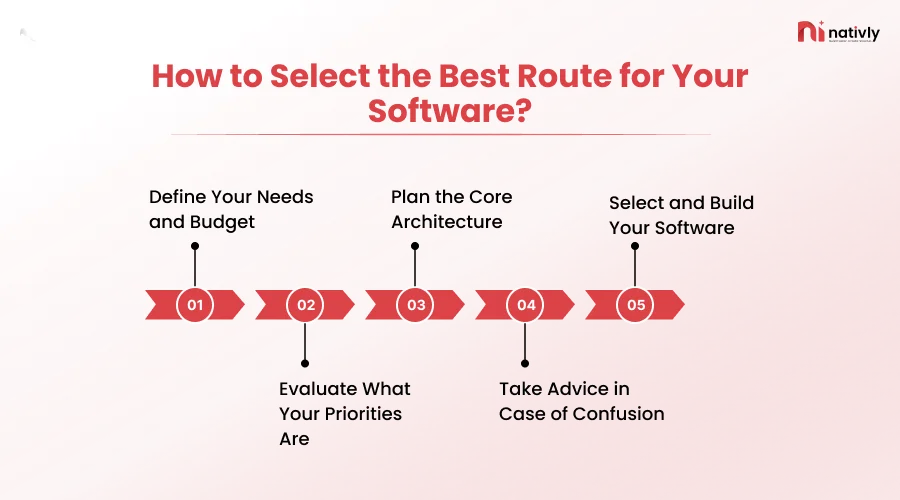
When you are going ahead with selecting the best route for your software, it is important to follow a series of steps:
Step 1: Define Your Needs and Budget
In this first step, you should define your needs and all the budget requirements.
You should evaluate the given scenarios:
- Core pain points by listing your biggest routing challenges.
- List all the non-negotiable features.
- Consider what your end users want.
- Check the complete system integrations.
If you want software within a few days or in 1- 2 months, an AI app builder like Nativly is the best option.
If you can wait for the next 2-3 months, or even more, hiring a software developer can be the best option.
Step 2: Evaluate What Your Priorities Are
Now, at this step, you should evaluate what your priorities are by identifying your core operational constraints and even what failure looks like for a typical day.
Here’s how you need to evaluate what your priorities are:
- Measure volatility and change
- Identify binding constraints
- Align features with your core business needs.
- Evaluate how dynamic your workflow is.
If your priorities are to launch your app via an AI app builder, you can focus strictly on a single, well-defined core feature rather than trying to create a complete, complex system; then you can consider an AI app builder like Nativly.
If your priorities are to create a complete app, that too with an expert developer’s advice, you should consider hiring a developer.
Step 3: Plan the Core Architecture
Planning the core architecture comprises defining your requirements, evaluating the business needs, scaling limits, as well as team capabilities rather than following popular trends.
Here’s how you need to identify how to plan the core architecture:
- Prioritize system stability, scalability, and business alignment first.
- State the type of core architecture that you want for your software.
- Protect sensitive data and user privacy from external and internal threats.
If you are planning the core architecture, too, in a similar or within the same frame, then selecting an AI app builder like Nativly can be helpful.
However, if you want to build the complete and core architecture from scratch, hiring a developer can be helpful.
Step 4: Take Advice in Case of Confusion
You should connect with experts or even developers to identify whether it’s good to go with an AI app builder or if hiring a developer can help.
This is what you should analyse:
- Consider connecting with top developers through different platforms.
- Assess scale and performance limits by estimating potential growth of your app.
- List the complete constraints and discuss all your doubts with developers.
Connecting with the developers will be helpful in both contexts.
Step 5: Select and Build Your Software
Now, it’s time to select and build the complete software. You should ensure that your project solves core issues efficiently without wasting time and money.
This is what you should do:
- Talk to the experts to ensure you are going down the right route.
- Verify and test efficiently and smoothly.
- Now, you can start building it: AI app builder vs. hiring a developer.
Which is the Best AI App Builder for Your Software?
Nativly is the best AI app builder because it bridges the gap between prompt-based generation and true native mobile deployment (iOS and Android).
This AI app builder combines natural language prompts with real, compilation-ready React Native code and even tested infrastructure.
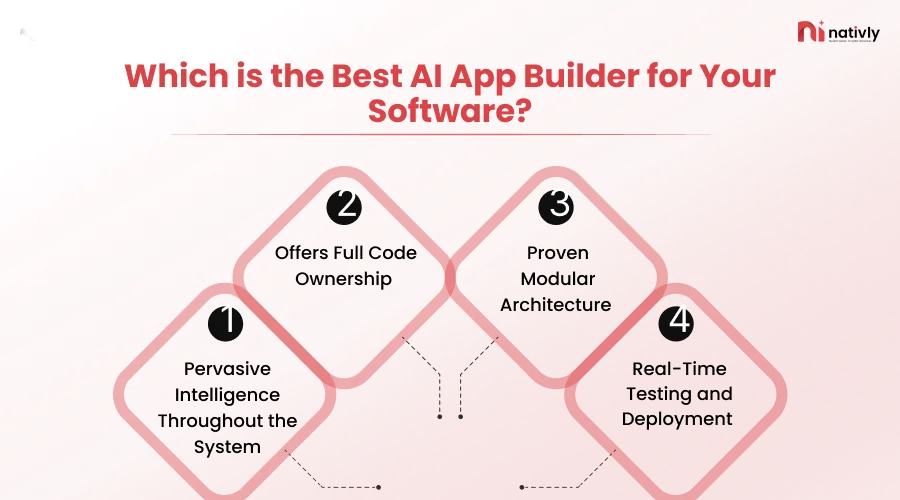
This is why you need to select and go with Nativly:
-
Pervasive Intelligence Throughout the System
Nativly offers end-to-end AI integration by using advanced models like Claude at every phase, covering feature conceptualization, raw code generation, as well as automated error corrections. The platform does offer contextual awareness.
-
Offers Full Code Ownership
Nativly is a platform that offers full code ownership, so you can avoid vendor lock-in and can take the application off the platform wherever you want. This is a platform that offers code ownership by generating real and exportable source code.
-
Proven Modular Architecture
When you connect with Nativly, you can get a proven modular architecture by shifting away from generating raw code entirely from scratch. Additionally, Nativly AI connects your app with the latest technologies and infrastructure.
-
Real-Time Testing and Deployment
Nativly AI offers real-time testing and effective deployment as it uses loop-based autonomous agents as well as pre-built production modules.
Conclusion
AI app builder is a suitable tool where it gets the benefits such as rapid prototyping, natural language coding, reduced upfront costs, and is great for internal tools. On the other hand, when it comes to hiring a developer, you should clarify all the project requirements, test the practical coding skills, and then evaluate the soft-skill communication.
Selecting the right platform depends on different factors such as evaluating your priorities, planning the core architecture, taking advice in case of confusion, and then building the software.
FAQs
Q1. What is the key difference between an AI app builder and hiring a developer?
The key difference between an AI app builder and hiring a developer is all about your requirements for the software. If you want fast software and wish to turn your ideas into working software instantly, then an AI app builder is the right choice. However, if you want customized software and are confused about the right use of technologies, then hiring a developer should be the choice.
Q2. What is an AI app builder?
An AI app builder is a software platform that uses artificial intelligence to help users create mobile or web applications with minimal coding. It can automate tasks such as designing interfaces, generating code, and adding features.
Q3. Why hire a mobile app developer?
The key reasons to hire a mobile app developer are technical expertise, customization and scalability, security and maintenance, along with time and cost efficiency.
Q4. How to select between an AI app builder and hiring a developer?
You can select between an AI app builder and hiring a developer by defining your budget and needs, planning the core architecture, seeking advice in case of confusion, and then selecting and building the software in the end.
Q5. Why consider Nativly AI as a top platform?
Consider Nativly AI as a top platform to build your software because it turns simple English into production-ready AI apps. Here, the key advantages include intent-driven creation, context preservation, and even fast cloud deployment.