TL;DR
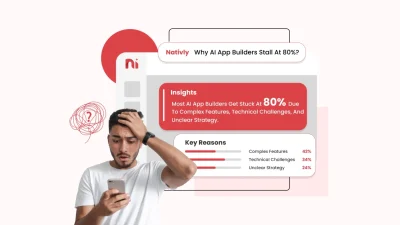
- Most AI pilots never become real products. MIT’s 2025 research found that 95% of companies saw no clear return from generative AI. That figure comes from early research, so take it as a warning sign, not a fixed fact.
- The AI itself is usually not the problem. Pilots stall because the goal is unclear, the tool doesn’t fit how people work, the data is messy, or nobody planned what happens after the test.
- An AI app builder makes the test cheaper and faster. You get a working app in front of real people sooner, before you have spent a big budget.
- It won’t fix everything. Bad data and unclear goals still need your attention.
- Easy way to start: one task, one goal, one 30-day test.
- Nativly lowers pilot risk by pairing AI that builds your native iPhone and Android app with engineers who help to launch.
How Often Do Enterprise AI Pilots Fail?
Often. Studies report different numbers because they measure different things, but they all agree that many AI pilots never go live.
| Who | What they found | What they looked at |
| MIT NANDA (2025) | 95% of companies saw no clear business return. Only 5% of custom-built AI tools have real use. | Generative AI pilots |
| Gartner (2024 prediction) | 30% of generative AI projects would be dropped by 2025 after the early test stage. | Projects abandoned after testing |
| S&P Global Market Intelligence (2025) | 42% of companies dropped most of their AI projects, up from 17% the year before. The company scrapped 46% of its early tests before launch. | Survey of 1,000+ people |
One note before you quote the 95% number. The MIT report says it was an early version, based on a small, anonymous group, and relied on companies’ reports. So, it is a useful signal, but not a number to treat as exact.
Why Do Most Enterprise AI Pilots Fail?
Usually because of business and planning issues, not weak AI. MIT’s lead author said the real issue is a gap between how the tools work and how companies actually work.
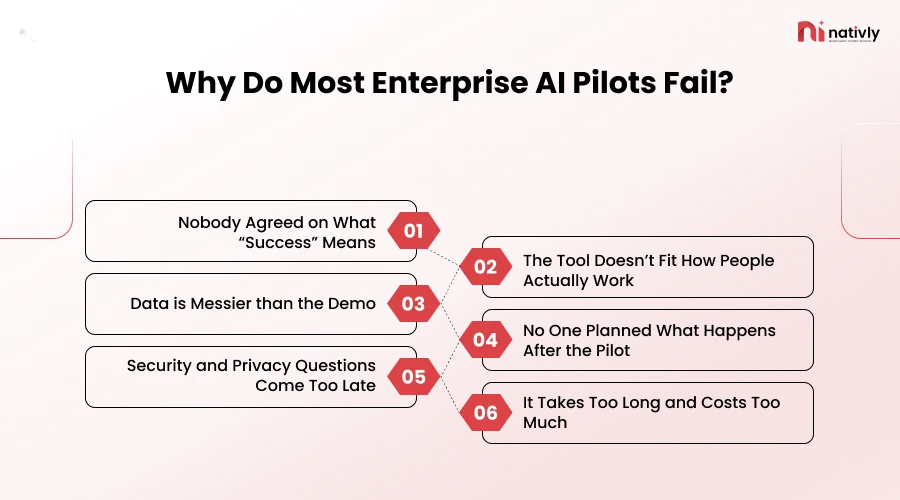
1. Nobody Agreed on What “Success” Means
Many pilots start with “let’s try AI.” A better start is “let’s cut the time it takes to handle a claim by 20%.” If you don’t know where you are starting or where you want to end up, you can’t tell if the pilot worked. Gartner listed unclear business value as the chief reason projects get dropped.
2. The Tool Doesn’t Fit How People Actually Work
If people have to leave their regular tools to use the new one, they stop using it. A chatbot that people try a few times, forget later. MIT’s author said enterprise AI should be integrated into the systems people already use, or pilots rarely move beyond testing.
3. Data is Messier than the Demo
A pilot often runs on a small, tidy data set. Real life is distinct. Real data is spread across systems, full of gaps, and out of date. Gartner points out poor data quality as one reason why projects get dropped after testing.
4. No One Planned What Happens After the Pilot
A pilot shows that an idea can perform well in a controlled setting. Going live takes more: support, security checks, an owner, monitoring, and sometimes app store approval. Teams that skip this planning generally realize after most of the budget is gone.
5. Security and Privacy Questions Come Too Late
S&P Global found that data privacy, cost, and security risks were the top obstacles companies faced. Asking those questions in the sixth month, instead of the first week, would end a pilot.
6. It Takes Too Long and Costs Too Much
Gartner said generative AI costs are harder to predict than other technology costs. If a pilot takes a year and a large team just to show a first version, the funder loses patience before outcomes show up.
What is an AI app builder?
It’s a tool that turns a plain description of an app into a working app, usually without requiring you to write any code. It shortens the time between “I have an idea” and “people can try it.”

Not all builders are the same. Some build web pages that only look like apps, while others make real native apps. Some stop at a rough prototype, while others involve engineers to help you build a launch-ready app. Those differences decide whether a builder helps your pilot succeed or only gives you a nicer demo.
Nativly is an AI app builder for native Android and iPhone apps. Its approach is simple: you explain your idea without code, its AI builds the app, and its engineers help launch it. It doesn’t use web wrappers.
How do AI App Builders Reduce the Risk of a Failed Pilot?
They put a working app early in front of real users and (with the right platform) give you a way to launch, making testing faster and cheaper. They address practical reasons pilots fail but don’t solve strategic problems.
| Why pilots fail | How an AI app builder can help |
| Slow and expensive to start | Builds a working app from your description; real users can try it sooner |
| Tool doesn’t fit how people work | Lets the team that knows the process shape the app and improve it from feedback |
| No plan to go live | Platforms with engineering help aim to turn a prototype into an app you can release |
| Overruns wear out sponsors | Smaller scope and quicker rounds show results before patience runs out |
| People don’t use it | A purpose-built mobile app your team uses every day is easier to adopt than a generic chatbot. |
Two things are worth pointing out.
1. Native Apps Feel Right on a Phone
A native app performs the way people expect their phone to. Apps that look like web pages in disguise can feel clumsy, and these pilots get abandoned.
2. Real Engineers Help You Finish
The most common spot pilots die is a prototype nobody can ship. A builder that pairs AI with engineers focuses on that gap.
What Can’t an AI App Builder Fix?
It can’t fix bad data, unclear goals, or a team not ready for change. A builder makes building cheaper. It doesn’t tell you what’s worth building.
Keep these limits in mind:
- If your data is unreliable, a faster app only offers you bad answers faster.
- If you work in a regulated industry, you still need your security, legal review, and compliance. Ask any vendor, including Nativly, for up-to-date details before you commit.
- Builders work perfectly for clearly defined tasks. Large, company-wide changes still demand proper system planning.
How Do You Run an AI Pilot That Actually Goes Live?
Choose one goal you can evaluate, keep the scope small, plan how to launch from day one, and fix a date to decide.
Use this checklist:
- Pick one problem people face today and one task that has a clear owner.
- Write down where you stand today, and where you want to reach. For example, save hours or cut mistakes.
- Check the data early. Know what the app needs and who controls it.
- Bring in security and compliance in week one, not the sixth month.
- Decide what “live” means. Who supports it? How is it released and watched?
- Get real users on it within the first few weeks.
- Set a “scale it or stop it” date. Agree in advance what outcome earns more budget.
Check an example below showing how that could look.
A field-service team needs technicians to log job notes from their phones. Instead of a long project that could take a year to complete, they build a small app and have a few technicians test it for 30 days.
Then they compare how long jobs take to close against the old way. If it works, they grow. If it doesn’t, they lose only a few weeks, not a year.
Where Does Nativly Fit In?
Nativly is a good fit for testing a mobile app idea quickly and getting a real way to launch on Android or iPhone.
Based on what Nativly publishes, it allows you to build native Android and iPhone apps without code, develops the app from a simple description, and has engineers help get it ready to launch. It describes itself as built for businesses, creators, and startups, with users like service apps, business apps, and eCommerce apps.
If your pilot idea is a mobile app, that blend will get your first test running rapidly while keeping the door open to a full launch.

Conclusion
Most AI pilots don’t fail because the technology is bad; they fail because the goal was unclear, the tool didn’t fit how people work, and nobody planned to launch. An AI app builder won’t fix your strategy, but it makes it much cheaper to find out whether an idea works.
FAQs
Q1. Why do most enterprise AI pilots fail?
Most enterprise AI pilots fail because of planning and business issues, not the AI itself. The goal is fuzzy; the tool doesn’t match how people work; the data is messy; nobody plans what happens after the test, and cost and security questions come up too late.
Q2. What percentage of AI pilots fail?
It depends on the study. MIT found that about 95% of companies saw no clear return from generative AI. S&P Global found that 42% of companies dropped most of their AI projects. Gartner predicted at least 30% of generative AI projects would be abandoned after the early test stage. Each study counts something different, so don’t treat them as one number.
Q3. What is pilot purgatory?
It’s when an AI project stays stuck in the test stage. It never gets approved for real use, and it never gets shut down either. It usually happens when nobody decides what success looks like or when to make the call.
Q4. Can an AI app builder really reduce pilot risk?
Yes, in some ways. It cuts build time and cost, gets a working app to real users sooner, and can give you a way to launch. It can’t fix bad data or an unclear goal.
Q5. Is a no-code AI app builder good enough for a big company?
It can be, for clearly defined tasks, especially mobile ones. Before you roll it out, ask the vendor about security, compliance, and support.
Q6. How long should an AI pilot last?
Long enough to measure one result with real users, usually 30 to 90 days. Set the end date and the target before you start.