Key Takeaways
- To choose an AI app builder for your enterprise, define business goals, set must-have requirements, shortlist the AI app builders, validate enterprise readiness, and then compare the total costs and risks.
- Enterprises are looking for an AI app builder because of security and compliance, integration, governance, and control, as well as unclear costs and capabilities.
- An AI app builder really costs from $19/month to $199/month, based on different factors as per the requirements of the app.
- Connect with Nativly, the best AI app builder that will address all your issues successfully.
Selecting the right AI app builder helps enterprises move from idea to software faster; however, speed alone is not enough.
Here, teams should weigh security, compliance, integration, data readiness, governance, scalability, and costs before committing to an AI app builder.
This guide outlines a selection process, explains how AI app builders differ from no-code and low-code tools, reviews pricing considerations, and highlights what to assess when evaluating Nativly for mobile development.
Let’s get started with the same.
What is an Enterprise AI App Builder?
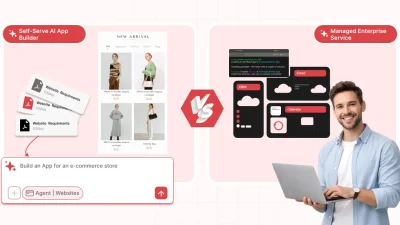
An AI app builder is a platform that uses artificial intelligence to generate, assist with, or speed up the creation of business software, turning natural-language descriptions into full-stack apps that meet security, governance, and scalability requirements.
A user can prompt the AI app builder with a plain-language description of the application. The system can then generate an app that fits the chosen programming language or framework along with the project’s requirements.
An enterprise AI app builder assists in creating business software via natural language prompts, visual editors, and governance controls.
This is how you can make an AI App Builder “enterprise-ready”
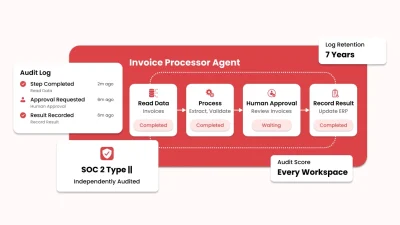
- Include the core security and governance parameters
- Evaluate the architecture and code quality
- Offer integration and monitoring
- Governance, quality gates, and testing
- The key pillars include natural language and visual generation, code transparency, and flexible deployment.
Here, one of the key questions that enterprises and startups often ask is “Why are enterprises struggling to choose an AI app builder?”
Well, enterprises are struggling to choose an AI app builder because of unpredictability and lack of control, data fragmentation, security and vendor lock-in, along with the production vs. prototyping gap.
Let’s study all the key reasons in the next section.
Why Are Enterprises Struggling to Choose an AI App Builder?
Enterprises are struggling to select an AI app builder because of the compliance framework, security, and deep business integration. The key areas where enterprises are struggling to select an AI app builder are:
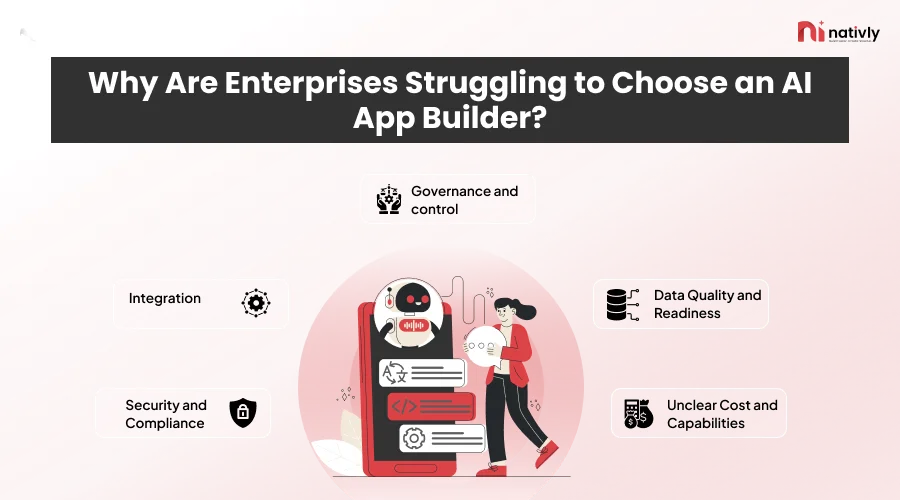
1] Security and Compliance
Security and compliance are the struggling factor to select an AI app builder because they are built to protect sensitive information, prevent users from paying heavy legal fines, and ensure that the app follows strict industry laws.
These are the unvetted tools that expose companies to massive financial penalties, breaches, and legal liability before writing a single line of code.
2] Integration
Integrations are key measures when selecting an enterprise AI app builder because modern AI applications cannot operate in a vacuum. Enterprises are struggling to select an AI app builder because of the integration parameters.
Connecting securely and reliably with existing databases is a key challenge for most of the enterprise apps. And when it comes to selecting an AI app builder, looking for the right integration partner is crucial.
3] Governance and control
Governance and control is a major factor impacting the selection of an AI app builder for your enterprise app because these enterprises transform experimental AI tools into safe, compliant, and scalable business systems.
While a specific tool can generate code or screens from a simple prompt in minutes, enterprise workflows handle sensitive data and regulatory compliance. Thus, it becomes difficult for enterprises to select a certain AI app builder.
4] Data Quality and Readiness
Poor data can cause up to 95% of generative AI pilots to fail because the AI models do not deliver accurate business value or generate costly, untrustworthy outputs.
Thus, maintaining the same level of data quality and readiness that they can have with app development with developers is one of the key attributes that most of the enterprises look for in this current era.
5] Unclear Cost and Capabilities
Sometimes the cost to use an AI app builder is not clear; thus, building an enterprise app from the ground up with AI is one of the key factors to consider when enterprises choose an AI app builder.
Additionally, usage-based volatility, hidden cost ecosystem, and vendor lock-in are the critical factors enterprises struggle to choose an AI app builder.
Now, the question is, “How to choose an AI app builder for your enterprise?”
Choosing an AI app builder for an enterprise requires you to evaluate the technical capabilities, data security, and long-term scalability. Now, for details, let’s get into the next section.
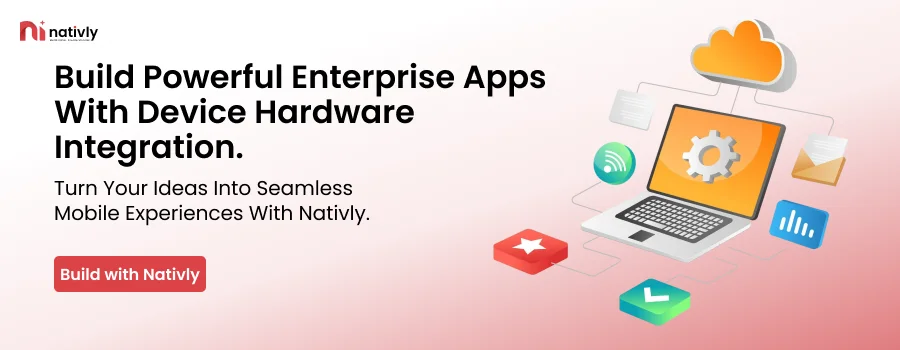
How to Choose an AI App Builder for Your Enterprise?
Define business goals and scope, evaluate enterprise security and compliance, assess integration and data governance, check data readiness, and determine the deployment platform.
Here are the details on how to choose an AI app builder for your enterprise:
Step 1: Define the Business Goals and Scope
This is the prime step to select an AI app builder for your business. If you are unaware of your app goals, it will result in scope creep.
You should evaluate:
- What is the core target audience of your enterprise app?
- State the demographics and state the customer persona of the target audience.
- Specify the pain point that your enterprise app will address.
- Align your operational problems with measurable outcomes, security standards, and technical boundaries.
One of the key parameter lies here is that you should validate your app idea before building it.
Step 2: Set Must-Have Requirements
In this second step, you should set must-have requirements while choosing an AI app builder for your enterprise. It’s all about balancing rapid development speed with strict corporate governance and long-term scalability.
This is what you should analyze:
- It requires balancing rapid development speed with strict security, governance, and scale.
- All the security and compliance requirements for your enterprise.
- Architecture and integration capabilities that include code export and ownership, along with enterprise integrations.
- Evaluate the governance and scalability with agent & workflow orchestration, usage and cost tracking.
Step 3: Shortlist the AI App Builders
To shortlist and choose an AI app builder for your enterprise, it is important to evaluate each candidate platform across core technical, operational, and scaling dimensions rather than relying solely on marketing pages.
This is what you should analyze:
- Evaluate the technical scope
- Check where your data lives
- Define the user roles and permissions
- Verify the post-launch operations and IT requirements
Step 4: Validate Enterprise Readiness
You should evaluate enterprise readiness as an important step to ensure that the platform satisfies strict security, compliance, deployment, and governance standards before you select any AI app builder for your enterprise.
This is what you need to consider:
- Set all the fail and pass requirements
- Confirm compliance fit by matching the documented certifications
- Review the complete data handling systems for your enterprise
- Check for the deployment options that your enterprise app can avail.
- Document gaps and get sign-off
Step 5: Compare Total Cost and Risks
Comparing the total cost of ownership and associated risks is the final evaluation gate that shifts an enterprise from pilot testing to a secure, long-term commitment when selecting an AI app builder.
This is what you need to consider:
- Token consumption and scaling
- Total cost of ownership (TCO)
- Infrastructure and hosting overheads
- System and data integration costs
- Maintainability and documentation
Step 6: Choose and Plan Rollout
Choosing and planning the rollout for an enterprise AI app builder requires you to balance rigid development speed with governance, security, and team readiness. It requires a structured approach that balances speed of innovation with data security and user adoption.
This is what you need to consider:
- Define the strategic objectives and guardrails
- Evaluate the enterprise-ready AI builders
- Plan a phased rollout
- Governance and lifecycle planning
Now, one of the key questions that most of the startups often ask is “no-code vs. low-code vs. AI app builders vs. AI coding assistant in the next section.
No-Code vs. Low-Code vs. AI App Builder vs. AI Coding Assistant
The major difference between no-code vs. low-code vs. app builder vs. AI coding assistant is in their app-building process.
Here is the complete list to consider:
| Type | What it is | Best for |
| No-code | Drag-and-drop builder with no code | Non-technical teams, simple apps |
| Low-code | Visual builder plus custom code | Business/IT teams, workflow apps |
| AI app builder | Generates a full app from a prompt | Founders and teams needing fast, working apps |
| AI coding assistant | Helps developers write code in their IDE | Engineering teams, existing codebases |
Bonus Read: AI App Builder vs Hiring a Developer
What Does an AI App Builder Really Cost?
The cost of an AI app builder varies based on the type of AI app builder you are choosing. Mostly, the AI app builder cost varies from $19/month to $199/month.
Here is the cost breakdown of how much it costs to build an enterprise app with an AI app builder:
| Monthly cost ($) | Typical inclusions | Typical limits |
| 19–29 (entry) | Basic AI generation, 1 app, limited prompts | Low usage caps, basic support, limited publishing and export |
| 49–99 (mid) | More prompts, multiple apps, backend and integrations, custom domains | Seat limits, some advanced features gated |
| 149–199 (top) | High usage, team access, priority support, advanced publishing and governance features | Heavy use or engineer support can still add extra costs. |
Why Connect with Nativly to Build Apps for Your Enterprise?
Nativly is the best AI app builder for enterprise app development platform because it builds real, native iOS and Android apps rather than simple web wrappers or non-native hybrid views.
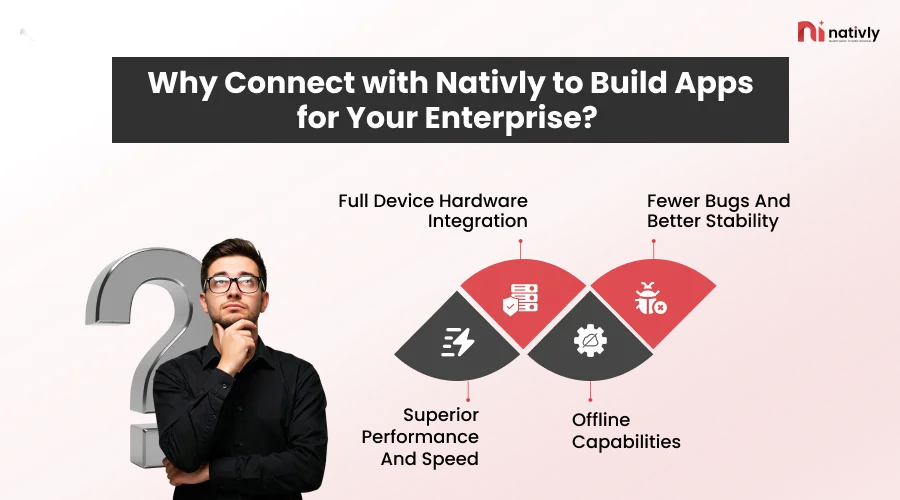
The key benefits of connecting with Nativly are:
-
Superior Performance and Speed
The native approach offers superior performance and speed by running apps directly on the device hardware and operating system, as well as reducing manual setup, but that doesn’t prove that the finished app runs faster.
-
Full Device Hardware Integration
Nativly offers hardware integration through wrapping the website content inside a native iOS and Android application shell with the help of an embedded mobile browser.
-
Fewer Bugs and Better Stability
Nativly offers a platform where you can create a complete app with the help of AI, with fewer bugs and better stability. This platform offers fewer bugs and better stability when building enterprise apps by combining AI-driven code generation with native platform execution.
-
Offline Capabilities
The nativly platform enables offline capabilities by bridging the native device storage with the underlying web or backend infrastructure. It offers on-device data persistence, local storage mechanisms, and local execution options.

Conclusion
Selecting an enterprise AI app builder is a strategic decision, not just a technology choice. Start with a defined use case and measurable outcomes, then assess platform fit, security, data, integrations, deployment, governance, and support.
Validate claims through a realistic pilot and compare total ownership costs, including usage, integration, hosting, and maintenance.
Nativly may suit teams seeking mobile experiences; confirm that its capabilities, hardware access, operational controls, and app behavior meet your requirements. Roll out in phases, then monitor adoption, performance, and risk.
FAQs
Q1. What should enterprises prioritize when choosing an AI app builder?
Prioritize security, compliance, integration, governance, data readiness, scalability, and maintainability. Compare platforms against your organization’s requirements and validate them with a pilot.
Q2. How can an enterprise test an AI app builder before adopting it?
Build a representative, low-risk app and test its integrations, performance, security controls, and ease of maintenance. Document gaps and get stakeholder approval before expanding use.
Q3. How much does an AI app builder cost?
Pricing varies by platform, usage, features, team size, and hosting needs.
Include integration, infrastructure, support, and maintenance when estimating total cost.
Q4. Does Nativly support device hardware integration?
Confirm that the specific features your app needs, such as camera, GPS, or offline storage, are supported. Test them in a pilot; wrapping web content in a native shell does not automatically guarantee full hardware access.