Key Takeaways
- Vibe coding is a trend where users or founders can build their own apps and websites using AI with higher-level natural language instructions.
- To use vibe coding, the user can start with prompting and testing the results, then adding or reframing the prompts, and then deploying it on a trusted platform.
- The non-technical founders are turning to vibe coding because of its speed and accuracy to product, flexibility in software development, and lower barrier to entry.
- The popular vibe coding tools are Lovable, Bolt.new, vO by Vercel, Replit Agent, and Cursor/Copilot.
- The real risk of vibe coding includes security risks, messy code, operational and maintenance issues, and no-long term structure.
- Connect with Nativly, an AI app builder, to create your own app via vibe coding.
What is Vibe coding?
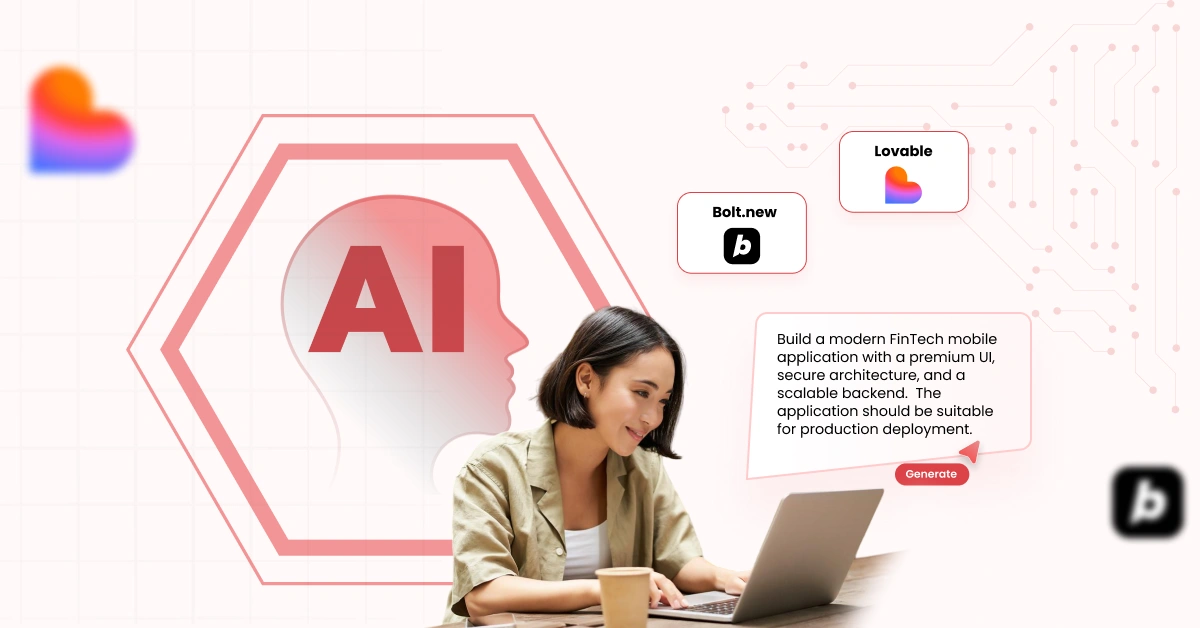
Vibe coding is a software development trend where a person builds apps or websites by giving high-level natural language instructions to an AI rather than writing the complete code line-by-line.
Simply, it means a growing trend where developers use large language models (LLMs) to generate functional code by simply describing what they need in plain language. Instead of writing each line, they rely on AI to translate the natural language into executable code.
One of the important note here is that vibe coding does not eliminate the need to understand the code. You still need to write what the AI produces, test it, and need to evaluate whether the written code is correct or not.
Now, let’s examine how vibe coding works:
How Does Vibe Coding Work?
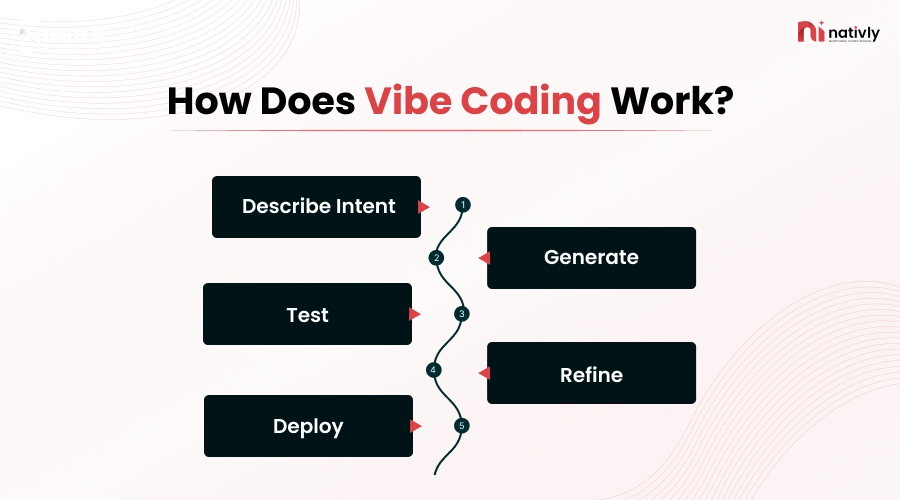
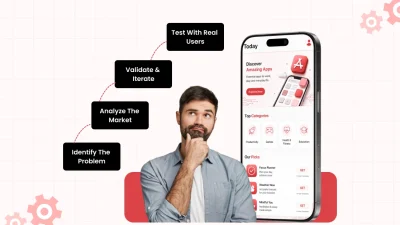
Step 1: Describe Intent
With simple plain language, you need to describe your intent, such as what type of app you want, stating all the requirements clearly.
Step 2: Generate
Now, the AI tool does all the coding work and creates the app or software as demanded.
Step 3: Test
You can test the app and software under your parameters.
Step 4: Refine
Refining the vibe coding comprises moving from loose, chaotic prompts to a structure and intent-driven AI orchestration. Perform a little coding if necessary.
Step 5: Deploy
Now, you can deploy your app or software on the targeted platform.
Through vibe coding, founders and startups can use AI to create an Android and iOS app without coding.
Along with vibe coding, there are other platforms and technologies in the market, such as no-code development and traditional development. All three may sound similar to you, but they are way more different.
Many app startups often ask the difference between vibe coding vs no-code vs traditional development.
The following section includes the complete list of differences.
Vibe Coding vs No-Code vs Traditional Development
Vibe coding is extremely fast for prototypes and small features, while traditional coding is slower upfront and faster later because of less rework and fewer incidents. While at no-coding, you build the platforms with drag-and-drop tools, blocks, and even pre-built connections.
In the given table, let’s study the difference between vibe coding, no-code vs traditional development:
| Dimension | Traditional Development | No-Code / Low-Code | Vibe Coding |
| How you build | You (or a developer) write code line by line | You drag, drop, and configure pre-built visual blocks | You describe what you want in plain English; AI writes real code |
| Underlying output | Custom source code | Proprietary configuration inside the platform; it is not standard code. | Actual, editable source code (React, Python, etc.), generated by AI |
| Skill required | Programming languages, frameworks, architecture | Platform-specific logic (workflows, data bindings) | Clear communication and the judgment to review AI output |
| Speed to prototype | Slow (weeks to months) | Fast (days) | Fastest (hours to days) |
| Customization ceiling | Unlimited; here you can build anything | Limited to what the platform allows | High, but only as good as the AI’s output and your review. |
| Portability | Fully yours; move it anywhere | Locked into the platform (vendor lock-in) | Yours; code is exportable, but often needs cleanup to run well elsewhere. |
| Security & compliance | Built and reviewed by developers who understand risk | Platform handles baseline security, but customization is limited | Frequently ships with gaps (weak auth, missing input validation, exposed secrets) unless audited |
| Scalability | Built for scale from the start (if planned well) | Struggles past a certain user/traffic threshold | Fine for a prototype; usually needs re-architecture to handle real traffic |
| Best for | Production apps, regulated industries, apps built to scale | Internal tools, simple workflows, non-technical teams with static needs | Validating an idea fast, building a clickable MVP, pitching before you fundraise |
| Who should use it | Founders with a dev team or a development partner | Non-technical teams with simple, low-risk use cases | Non-technical founders in the idea validation stage |
Vibe coding has become one of the essential tools, where founders build and launch functional, full-stack applications in days or hours instead of months.
Bonus Read: “Bolt vs Lovable vs Raplit vs Nativly”
Why Are Non-Technical Founders Turning to Vibe Coding?
Non-technical founders are turning to vibe coding because it eliminates the development bottlenecks, lowers the cost of curiosity, and further turns domain expertise into functional software.
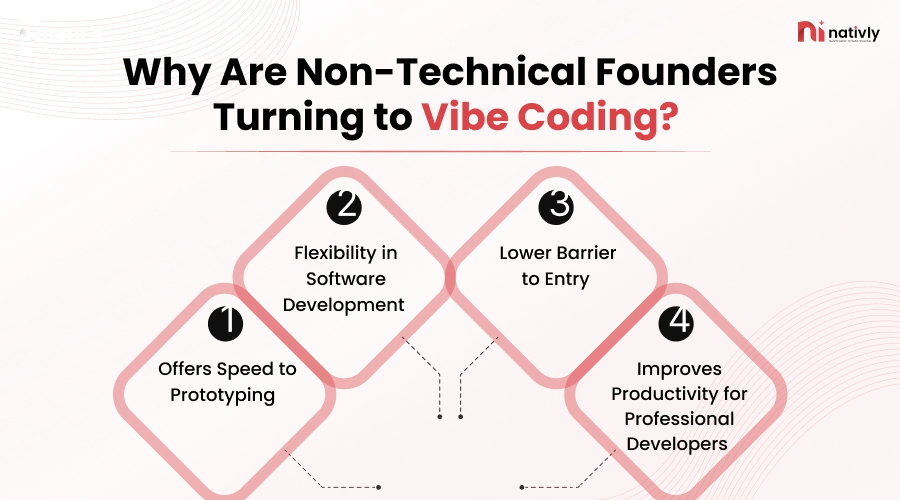
As you know, what is vibe coding? Let’s learn why the non-technical founders are turning to vibe coding:
-
Offers Speed to Prototyping
The non-technical founders are turning to vibe coding to skip the traditional development hurdles, lower costs, and rapidly test business ideas.
This even helps developers not spend much on creating a prototype, and is helpful to turn the ideas into working software in days or hours. It eliminates the time spent on making a complete prototype.
-
Flexibility in Software Development
Vibe coding helps the developers to create a software just by chatting with AI in plain language. This accessibility is revolutionary for entrepreneurs, designers, and business professionals, who previously had to hire developers.
Now, they can create their own app just by typing a few sentences and detailing all the requirements.
-
Lower Barrier to Entry
This approach addresses the issue of what programmers call “ the blank page problem”. It helps developers to overcome the initial hurdle of beginning the project.
This vibe coding helps address the barrier to entry through replacing complex syntax memorization with natural language instructions.
-
Improves Productivity for Professional Developers
When it comes to AI tools, these tools are invaluable when developers want to experiment and implement improvements. Hence, these developers and even senior developers turn to vibe coding that helps them to edit the code without correcting every line.
These developers just need to add a prompt and can even do it by themselves. Senior developers can leverage vibe coding for handling repetitive tasks.
As a fintech startup or a business startup, you might be wondering about whether there is any vibe coding tool that these startups and developers use.
Well, let’s understand these vibe coding tools in the following section.
Popular Vibe Coding Tools that Founders are Using in 2026
The leading vibe coding tools that founders use are Lovable and Bolt.new, vO by Vercel, and many others.
If you are clear about what is vibe coding, and its benefits, then let’s understand the different tools under vibe coding:
-
Lovable
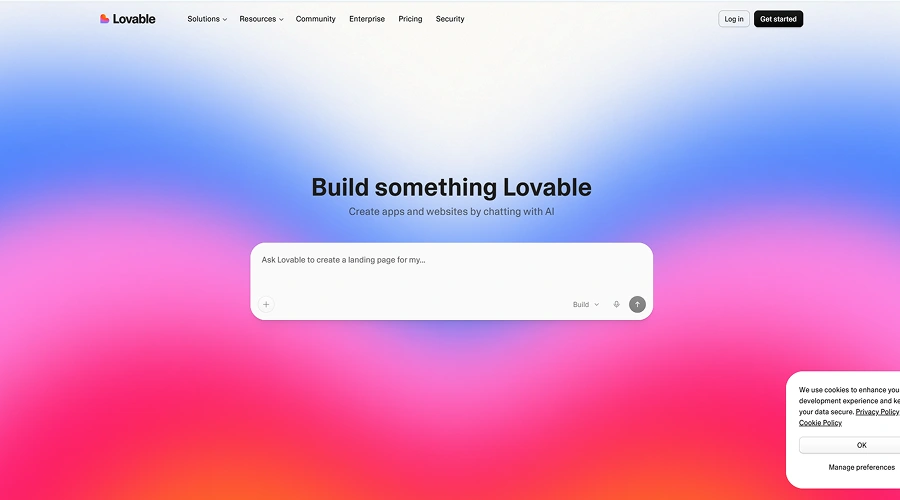
Founders use Lovable for creating full-stack web applications, helping the founders build, test, and even launch web applications via natural language chat prompts. Here, the price ranges from free tiers to $25/month.
-
Bolt.new
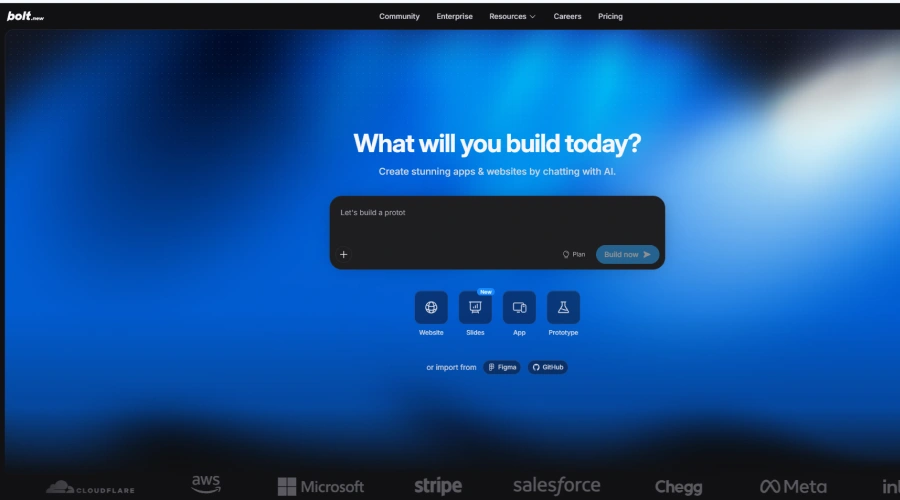
Bolt.new is a vibe coding tool that helps founders create, run, and even deploy full-stack web apps for rapid prototyping and GitHub sync. It allows developers to skip the manual server setups.
-
vO by Vercel
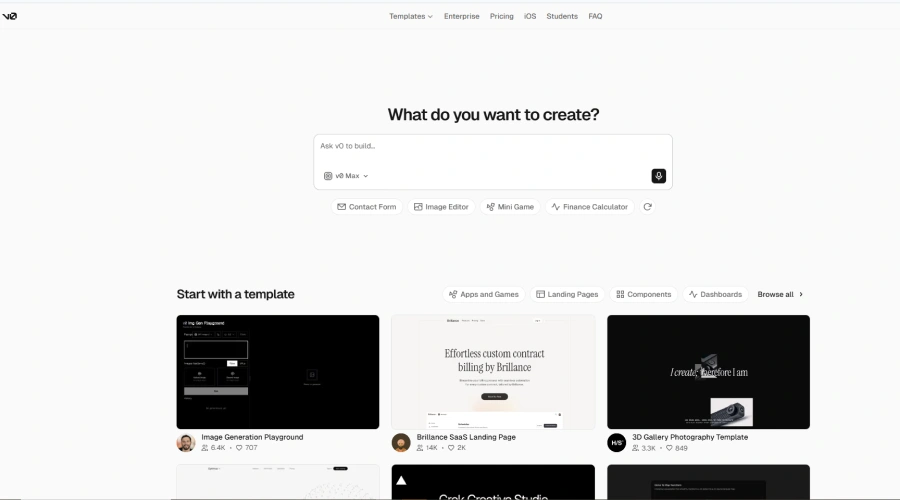
The use of vO by Vercel is not only to turn plain languages into prototypes, but also to use screenshots to help convert them into the expected software.
-
Replit Agent
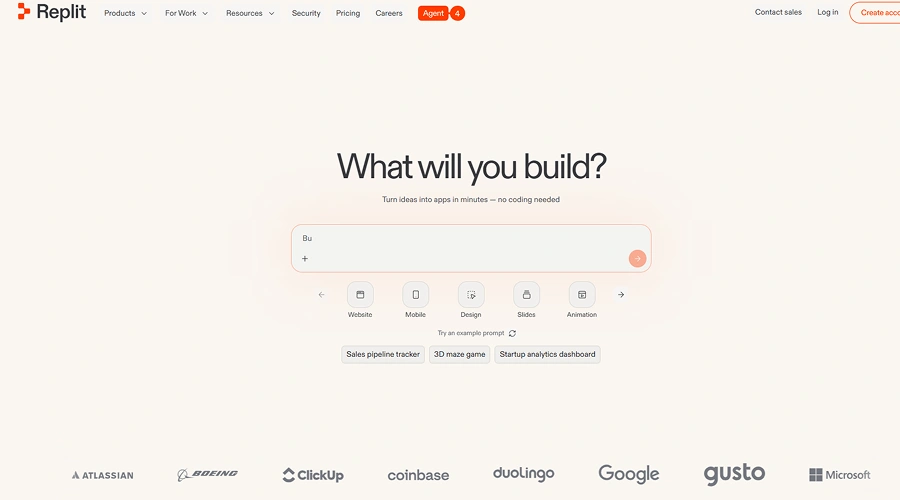
The Replit Agent shifts the vibe coding tool from writing code to directing it into an AI companion with the help of everyday language. This tool handles the building, testing, and deployment of the app.
-
Cursor/Copilot
With the help of cursor/copilot, you write complete software describing what you want in plain English, while letting AI handle the implementation. You can use the conversational chat and autonomous features to create apps via natural language prompts.
These are tools you can use while opting for vibe coding. But is there any risk of vibe coding? Let’s get ahead to understand the same in the following section.
The Real Risk of Vibe Coding
The major challenges and risks in using vibe coding are through natural language AI prompts, where your app might face issues related to security, technical debt, scalability, and compliance blind spots.
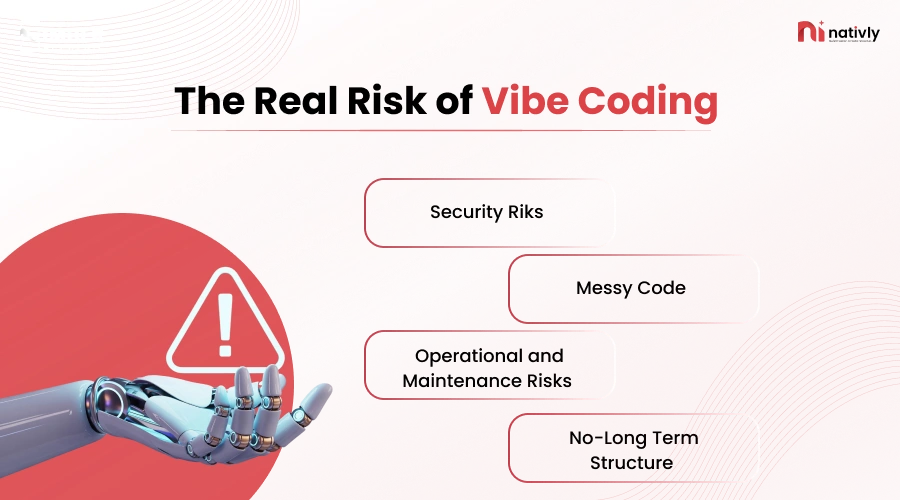
Here is the complete list of challenges and real risks of vibe coding:
-
Security Riks
One of the major risks falls in security; as a startup or a founder, you provide the commands to convert your idea into reality. The code generated by vibe coding can be insecure due to the training data; here, AI might skip the validation phase.
-
Messy Code
Here, AI might generate insufficient and even hard-to-maintain code. Developers need to clean up as you go and keep things modular. Here, vibe coding can get messy as AI prioritizes making features work over long-term system designs.
-
Operational and Maintenance Risks
The operational risk encompasses the potential for losses due to inadequacies, internal procedures, and other risks that are associated with external factors like market fluctuations.
-
No-Long Term Structure
One of the major demerits of using vibe coding is that projects can become chaotic. Additionally, vibe coding relies on rapid, high-level natural language prompts rather than intentional architectural design.
But as a founder, owner, or startup, there can be certain pain points that non-technical founders might face.
If your AI-generated app got rejected by the App Store, connecting with a wise AI app provider that is backed by senior developers can help.
The experts of the best AI app provider, Nativly, found that the use of vibe coding has been a challenge for non-technical founders. Let’s focus on them all in the following section.
What are the Common Pain Points Non-Technical Founders Face?
Here is the list of the pain points that experts at Nativly have gone through while dealing with startups and founders using vibe coding:
| Founder Pain Point | How Nativly Helps |
| “My AI prototype works in the demo but breaks under real users” | Production-grade rebuild with scalable architecture, QA, and load testing |
| “I don’t know if my app is secure or compliant” | Security audits, KYC/AML/PCI-DSS-ready fintech development |
| “I can’t tell good AI-generated code from bad code” | Technical due diligence/code audit before you scale or raise funding |
| “I don’t have a technical co-founder to guide decisions” | Dedicated project manager + engineering team acting as your technical partner |
| “I don’t know what an MVP should actually cost” | Transparent MVP pricing and scoping — see MVP Development services |
| “I built something in Bubble/Lovable but need to scale it” | Migration from no-code/vibe-coded prototypes to custom, investor-ready software |
If you are among them and facing issues with using vibe coding, or are not aware of which tool is best in your case, then connecting with the experts can help.
How Can Nativly Assist in App Development Using AI?
Nativly is the best AI app builder that helps developers create their own app using artificial intelligence. It is a tool where developers and startups just need to write prompts in simple language, and Nativly handles the rest.
For startups and developers looking for AI app development, the developers support users in creating an app or a platform using vibe coding. Here, the developers will guide startups in every step where they face complications. It is a tool that is backed by top engineers, where you can focus on prompting only.
Here’s how Nativly can help you:
- Accelerate Product Development: With Nativly, users can speed up their app development process. They just need to type the right prompt to get the actual platform and app required.
- Reduce Manual Workloads: Nativly minimizes the manual workload through automating the generation and maintenance of mobile apps for built-in native device features.
- Democratizing App Creation: This tool democratizes app creation through lowering the technical and financial barriers. This platform offers everything required to ship a real app, from real-native mobile apps to cloud AI at every stage.
- Attractive Pricing: The pricing of nativly begins from $15 per month, which is very reasonable when it comes to creating an app or platform via AI.
Conclusion
Vibe coding is a platform where users use plain natural language prompts to create apps instead of writing the complete code. It offers startups and founders a way to speed up their product development.
The real risk of vibe coding comprises security risks, messy code, operational and maintenance issues, no-long term structure, and operational as well as financial risks. Connecting with the right AI app builder can be helpful here.
FAQs
Q1. Does Nativly have its own vibe coding tool?
Yes, Nativly has its own vibe coding tool and platform where founders can write a simple prompt to get an app or software. Here, the developers get a reliable and engaged platform via vibe coding because it creates apps with speed and accuracy and is flexible to use.
Q2. What are the real challenges of using vibe coding?
The key challenges of using vibe coding include security risks, messy code, operational and maintenance issues, and no-long term structure.
Q3. Are there any tools of vibe coding already present in the market?
Yes, there are diverse vibe coding tools such as Lovable, Bolt.new, vO by Vercel, Replit agent, and the cursor tool. These tools vary in the use and output that they offer.
Q4. What are the common pain points that non-technical founders face?
There are different challenges that founders might face while using the vibe coding platform, such as issues related to the security of the code, operational and maintenance issues, and no long-term structure.
Q5. What is the difference between vibe coding, no-coding, and traditional coding?
Traditional coding is simply writing the complete code; it is the actual coding that developers opt for while creating the complete app, while in no-code, you drag and drop the configuration prompts. In vibe coding, you write prompts in higher natural language, and then the platform convert it to the app or software as demanded.